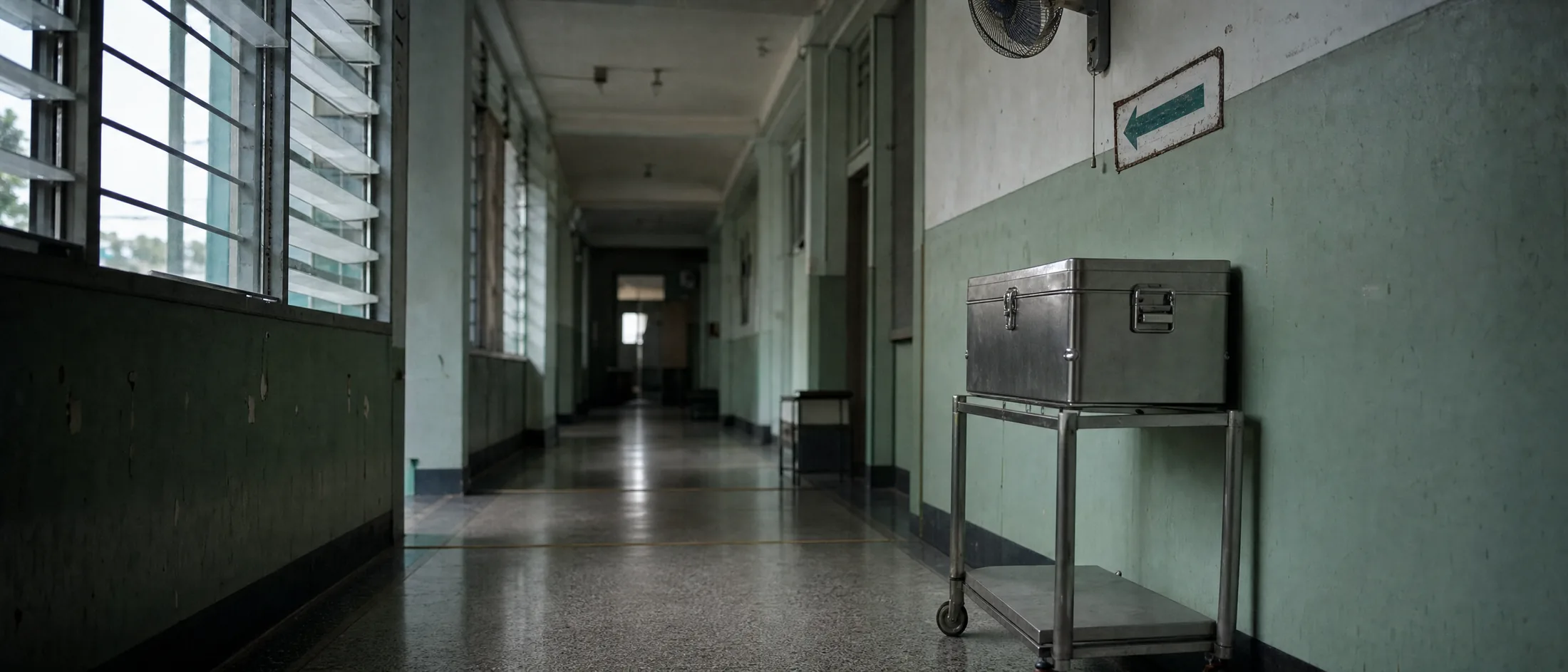
Nandito na kami.
The implant is already in the hospital.
At the Core of Better Care
In Philippine trauma orthopedics the operation does not wait on the surgeon's calendar. It waits on a piece of metal somebody has to go out and find — and usually that somebody is the patient's family. Bonecore takes that errand back.
Check the shelf.
Pick a region and a construct. This reads the live range — 130 catalogue lines — and tells you what a quotation would have to cover.
The wait is measurable. So is what causes it.
PhilHealth states the cause in its own governing circular: “the prohibitive cost of orthopedic implant devices is not entirely covered and thus becomes members' out-of-pocket expenses… Delayed surgeries are the consequence.” PC 2023-0007
There is no ordinary implant allowance in the Philippine case-rate system. Outside the Z Benefit package — contracted at 21 facilities nationwide as of 30 June 2026, with no contracted facility at all in Regions II, VIII, IX, XII or BARMM — the implant is not covered, and the purchase falls to the household.
Average wait to hip surgery.
IOF Asia-Pacific Regional Audit 2025Of hip fractures ever surgically managed.
IOF Asia-Pacific Regional Audit 2025Household out-of-pocket health spending, 2024.
PSA National Health Accounts 2024Of households cannot pay a ₱10,000 hospital bill without borrowing.
BCG, n=1,515 families
Who actually decides which implant goes in.
Take the core case: a government hospital, a service patient, urgent trauma. The purchasing decision does not sit where a supplier would expect it. The household is the purchasing agent — it carries the purchase order and waits for it to clear. One family's recorded timeline: “June 9 pinakita ko P.O. ko, July 8 operation.” A month between the purchase order and the operation.
Total health spending per Filipino is roughly ₱11,000 a year; a femur nail on a DOH consignment list is ₱34,000–₱85,000. That gap is why the binding constraint on this business is not price. It is what can physically be in the room in time.
What can be in the room in time — the hard constraint that precedes everyone's preference.
Whether any implant happens at all.
The construct — then the affordable brand that serves it.
Delivery, price, sizing, terms.
Largely outside the urgent case; decisive for standing stock.
A working model, not a measurement. Drafted from the research and published here so it can be argued with and corrected against real case logs. If your own numbers differ, that is the conversation we want to have.

A budget brand is judged eighteen months later.
The index operation is not where the risk sits. Removal is. One series put the complication rate for implant removal at 47%, with cold welding and stripped screw heads the most frequent problems; in a larger series of 1,274 screws, 1.1% stripped and 0.6% cold-welded, and a complicated removal ran 95 minutes against 42. Thread malalignment beyond 5° is enough to cause stripping — a manufacturing tolerance question, and therefore the principal's to answer, by name.
Two questions follow that nobody puts in a tender. If this fails, my name is on it, not yours. And: will you still exist in three years when I need a matching screw? The second one is ours, and the answer is a lot number recorded against the case.
What we put in writing.
Bonecore is the channel, not the metal. Every claim about material, tolerance, testing and registration belongs to the principal and is stated as theirs. These five belong to us, and they are the ones that can be checked.
Lead time
Quoted per line, per hospital, before you commit to a date.
Completeness
Every component of the construct — or we say plainly what is short.
Sterility
Sterile and non-sterile codes listed separately; sterile-barrier dates rotated.
Traceability
Lot and serial recorded against the case, per PhilHealth Circular 2023-0007.
Returns
Unused, unopened stock taken back without argument.
Every geometry the principal makes — including the ones we have never ordered.
Held stock and indent items are confirmed per hospital at quotation, with a written lead time. You should see the whole range and ask. Sizes are printed for every line, so the envelope can be checked before theatre rather than in it.
Nothing in the range matches that. Try a region, or ask us.
Screws, locking screws and end caps.
These are not a geometry decision — they travel with the construct, so they are listed by envelope rather than photographed. Each plate entry names the screw diameters its holes are cut for. The principal publishes a full screw-matching table — broach, tap, screwdriver and guide wire for every screw in both systems. Ask and we will send it as a single A4 sheet you can pin in the OR.
The compliance burden and the brand asset are the same object.
Ang bakal mo.
Lot
TI-2026-0418-C
Turn over
- Device
- Proximal Humeral Locking Plate
- Material
- Ti-6Al-4V ELI · principal's declaration
- Lot
- TI-2026-0418-C
- Serial
- 0000-4418-0071
- Supplied
- 2026-04-18 · 04:12
- Distributor
- Bonecore Medical · CMDR on file
Turn back
A card the strictest regulator in the world says we do not have to issue.
EU MDR Article 18 requires an implant card for implantables — and Article 18(3) expressly exempts “screws, wedges, plates, wires, pins, clips and connectors.” That is Bonecore's entire product scope.
The Philippines requires nothing at all. PhilHealth's Z011 claims rule already requires a serial number identifying the device and its manufacturer, so the data exists by law before anyone decides to be generous with it. Bonecore issues the card anyway. Its marginal cost is a printed card.
On the card, the lot number is the highest-contrast element on the object — above the brand mark. If the mark is more visible than the number, the design has inverted its own purpose.
What we may say, and what we may not.
Bonecore is a distributor. The law is precise about what follows, and the constraint happens to be identical to the strategy: the claims Bonecore is allowed to make are exactly the claims that are easy to substantiate and hard to attack.
- Availability — what is on the shelf, and where that shelf is
- Sizing and completeness of the construct
- Delivery, and the time of arrival, printed and signed
- Instruments travelling with the implants
- Price, in writing, before anyone commits to a date
- Lot and serial recorded against the case
- Material and alloy specification
- Manufacturing tolerance
- Mechanical testing and conformance
- Regulatory registration of the device
- Any claim about how the implant performs in the body
The count is the proof.
A printed count sheet is a designed artefact, because it is the thing that proves the promise. Delivery documentation carries a prominent time-of-arrival field, printed and signed. That is the service level made into evidence.
Bonecore does not photograph machine tools, CNC, gowned QC staff or cleanrooms. Those are the manufacturer's proof images, and borrowing them would be a claim we are not entitled to make.


He is the only person in this story who has stood at both ends of the errand.
Bonecore's founder story is load-bearing rather than decorative. Category founder stories are absent, or they are heritage claims. This one is a person who has been in the room when the metal was not there.
He appears here once, as an origin and not a campaign. Everywhere else he is simply the name on the only thing this site asks you to do.
Trauma is unplanned, so the number is the honest channel. Email reaches the same person: bonecoremedical@gmail.com
The geography decides the business.
Government tenders already write the service specification: a trained orthopaedic technician available 24/7, a warehouse within 15 km, delivery one day before surgery, sterilisation before use. The government wrote the requirement. Nobody has published a service level against it.
No Philippine courier or airline publishes a next-flight-out rate. LBC is 3–5 days to the Visayas, 4–6 to Mindanao. Being there before the incision cannot be honoured by shipping. It can only be honoured by holding stock inside the radius — which is why the cluster is chosen before the warehouse lease is signed, not after.
